
It’s 4:30 am. Milking starts in 30 minutes. You walk into the dairy, and something’s not right – a strange noise, a warning light, or worse, milk that isn’t cooling. You call your refrigeration technician, but the part you need is sitting in a warehouse in Melbourne and won’t arrive until Thursday.
Sound familiar?
For dairy farmers across the Kyabram region and the broader Goulburn Valley, this scenario plays out more often than it should. And in most cases, it’s entirely avoidable.
At Kyabram Refrigeration, we’ve responded to hundreds of emergency callouts over the past 40+ years. What we’ve learned is this: the farms that recover fastest from equipment faults aren’t the ones with the newest gear. They’re the ones with the right spare parts on the shelf.
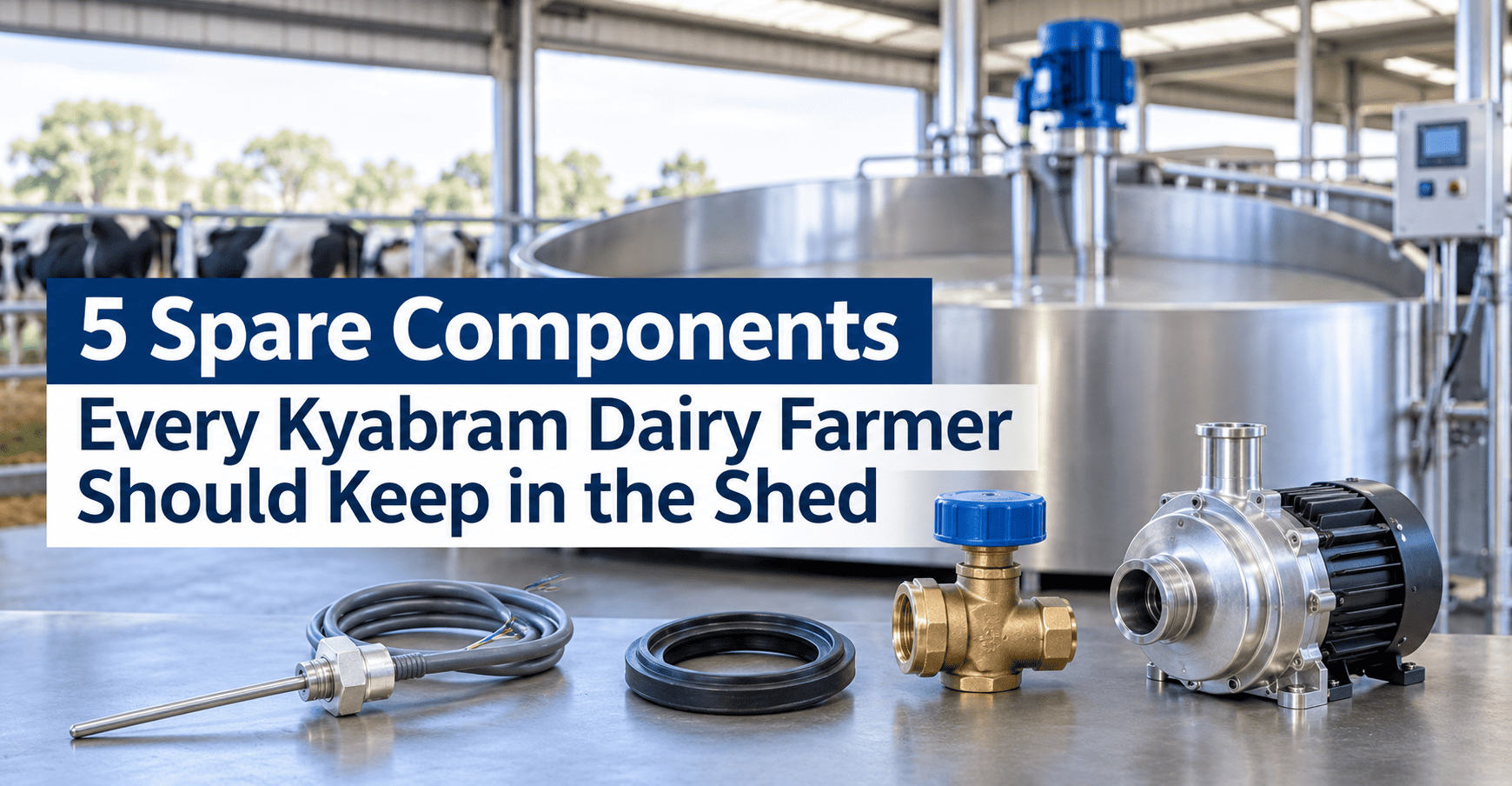
This article outlines the five most critical spare components every Kyabram dairy farmer should have ready in the shed. It explains exactly why each one matters to your milk quality, compliance, and peace of mind.
Why Stocking Spare Parts Is a Business Decision, Not Just a Convenience
Before we get to the list, it’s worth understanding what’s actually at stake when your dairy equipment fails mid-milking.
- Milk lost during a breakdown is revenue gone. You cannot reclaim it
- Delays in cooling can push your TBC over processor thresholds, triggering quality deductions or rejection
- Emergency after-hours callouts carry a premium. A spare part worth $80 can save you a $400+ emergency service fee
- Regulatory compliance doesn’t pause for equipment failure. Milk must reach 5°C within two hours, regardless of what’s gone wrong on your farm
Stocking the right spares is the difference between a 15-minute fix and a 3-day operational crisis. For farms milking twice a day, every day, that’s not a minor inconvenience. It’s a serious financial and food safety risk.
The 5 Spare Components Every Kyabram Dairy Farmer Needs
1. Milk Vat Agitator Seal (Shaft Seal)
Why it fails: The agitator shaft seal is one of the highest-wear components in your bulk milk vat. It operates in a wet, chemically active environment, constantly exposed to milk, cleaning acids, and caustic wash solutions. Over time, the rubber degrades, hardens, or cracks, leading to leaks around the agitator shaft.
What happens when it fails:
- Milk leaks from the agitator shaft into the vat insulation cavity
- Contamination risk increases significantly
- Undetected leaks can attract bacteria and compromise hygiene audits
- In worst-case scenarios, the entire vat contents may need to be discarded
Why you need one on the shelf: Agitator seals are vat-specific. They vary by brand (GEA, Westfalia, Packo) and model. If you don’t have one on hand when it fails, you’re waiting on a parts order. Given that Kyabram Refrigeration holds an extensive spare parts inventory for all major vat brands, we can advise you on the exact seal specification for your system, but having one pre-ordered and stored is always smarter.
Pro Tip from our technicians: Inspect your agitator seal visually every 3 months. Replace it at the first sign of weeping or discolouration around the shaft. Don’t wait for a full leak.
2. Refrigeration Contactor (Compressor Contactor)
Why it fails: The compressor contactor is an electrical switching component that controls power to your refrigeration compressor. It opens and closes hundreds of times per day whenever the thermostat calls for cooling. The contact points eventually pit, burn, or weld together from repeated electrical arcing. In a dairy environment, vibration and humidity accelerate this wear.
What happens when it fails:
- Compressor won’t start. Milk stops cooling immediately
- In some cases, the contacts weld in the closed position, causing the compressor to run continuously and risk overheating
- A failed contactor is one of the most common causes of emergency callouts we attend across the Goulburn Valley
Why you need one on the shelf: Contactors are relatively inexpensive, typically $50–$150, depending on the amperage rating. An experienced farmer or on-farm maintenance person can often replace one safely (always isolate power first). Having the correct one pre-matched to your system’s specifications is critical. An incorrect amperage rating can damage the compressor or pose a fire risk.
Pro Tip from our technicians: Check your existing contactor’s amp rating and voltage spec and write it on a sticker inside your dairy switchboard. That way, if we need to source one urgently, there’s no guesswork.
3. Milk Pump Impeller and Seal Kit
Why it fails: Your milk transfer pump works hard, pushing large volumes of milk at every milking, often while also managing cleaning cycles. The impeller (the rotating part that moves the milk) and the mechanical seal behind it are both subject to constant wear. Grit, residue buildup, and hard water scaling all contribute to degradation over time.
What happens when it fails:
- Milk flow slows or stops, backing up in the pipeline
- Air ingestion can cause excessive foaming, affecting milk quality
- A failed seal allows milk to leak externally, creating hygiene and waste issues
- In severe cases, a damaged impeller can introduce foreign material into the milk stream
Why you need one on the shelf: Impeller and seal kits are low-cost but highly farm-specific. Most major pump brands, DeLaval, GEA, and Boumatic, have their own seal kit configurations. Stocking the correct kit for your pump means a trained technician (or a competent farmer) can complete the repair at the next available window rather than grinding milking to a halt.
Pro Tip from our technicians: If your milk pump starts making a new noise, a whine, rattle, or grinding, don’t wait. That’s almost always the early warning sign before a seal or impeller failure. Early replacement costs a fraction of the cost of an emergency repair.
4. Vat Thermometer/Temperature Probe (Calibrated Replacement)
Why it fails: The temperature probe in your bulk milk vat is the device that tells you, and your processor, that milk has reached the required cooling temperature. These probes are electronic sensors typically immersed in the milk environment and repeatedly exposed to chemicals during CIP cleaning cycles. Sensor drift, coating, or physical damage can cause inaccurate readings without any visible sign of failure.
What happens when it fails:
- Your vat display shows milk as cooled when it may not be
- You risk delivering out-of-spec milk to the processor, a serious compliance and food safety issue
- Temperature logging discrepancies can trigger processor investigations
- If the probe fails to signal the thermostat correctly, your compressor may not activate when needed
Why you need one on the shelf: This is arguably the most underappreciated spare on this list. A faulty temperature probe gives you false confidence. Having a calibrated replacement probe means you can swap it out the moment a discrepancy is noticed, and verify your vat is performing to standard. Note: replacement probes must be compatible with your vat’s control system and should be calibrated before use.
Pro Tip from our technicians: Cross-check your vat thermometer against a calibrated hand-held thermometer at least once a month. If there’s more than a 0.5°C difference, your probe needs attention. Kyabram Refrigeration can test and recalibrate probes during a scheduled service.
5. Vat Inlet/Outlet Gaskets and Milk Line O-Rings (Assorted Set)
Why it fails: Rubber gaskets and O-rings are the unsung heroes of your dairy system. They create the airtight, hygienic seals across every connection point in your milk pipeline, from the vat inlet to the outlet valve to the CIP connections. Rubber degrades with age, chemical exposure, and temperature cycling. In a dairy environment, this process is relentless.
What happens when they fail:
- Micro-leaks introduce air into the milk line, causing foaming and elevated bacterial risk
- External leaks attract flies and contamination in the dairy shed
- Failed gaskets in CIP connections mean cleaning chemicals don’t reach the right areas, compromising sanitisation
- Processor hygiene audits flag deteriorated seals as a compliance risk
Why you need one on the shelf: Gaskets and O-rings are inexpensive and available in assorted kits covering the most common sizes used across GEA, Westfalia, and Packo systems. Having a full assortment on the shelf means any leak can be addressed the same day it’s noticed – no waiting, no workarounds. This is one of the best-value spare part investments on this list.
Pro Tip from our technicians: Do a full gasket inspection every six months. Look for flattening, cracking, or surface hardening. If a gasket has been in service for more than 2 years in a high-CIP-frequency dairy, replace it as a precaution regardless of appearance.
Quick Reference: Your Dairy Shed Spare Parts Checklist
| Spare Component | Risk if Missing | Approx. Cost | Replace Every |
| Agitator shaft seal | Milk leak, contamination | $30–$80 | 1–2 years or on inspection |
| Compressor contactor | Milk stops cooling | $50–$150 | On failure or every 3–5 years |
| Milk pump impeller & seal kit | Milk flow failure, foaming | $40–$120 | On failure or every 2–3 years |
| Calibrated vat temp probe | False readings, compliance breach | $60–$180 | On drift or every 3–5 years |
| Gasket & O-ring assortment | Leaks, CIP failure, contamination | $20–$60 | Every 6–12 months inspection |
Frequently Asked Questions
Q: How do I know which spare parts are compatible with my specific vat brand and model?
Compatibility varies between GEA, Westfalia, Packo, and other brands. The best approach is to call Kyabram Refrigeration directly with your vat model and serial number. We hold an extensive parts inventory and can confirm exact specifications for your system.
Q: Can I replace these components myself, or do I need a licensed technician?
It depends on the component. Gaskets, O-rings, and temperature probes can often be replaced by a competent farmer following manufacturer guidance. Electrical components, such as contactors, must be handled by a licensed electrician or refrigeration mechanic; working on live electrical systems without the correct licence is illegal and dangerous in Australia.
Q: How often should I schedule a preventative maintenance inspection?
For most dairy farms, we recommend at least one full system inspection per year, ideally before the summer peak when cooling demand is highest. Farms with older equipment or high milking frequency should consider bi-annual inspections.
Q: Does Kyabram Refrigeration stock spare parts for older vat models?
Yes. We carry spare parts for a wide range of makes and models, including older GEA and Westfalia units. If we don’t have it in stock, we’ll source it. Call us with your VAT details, and we’ll advise availability.
Q: What’s the most common reason for emergency callouts on Kyabram dairy farms?
In our experience, the most frequent causes are failed compressor contactors, agitator seal leaks, and temperature probe faults, all of which can be avoided or quickly resolved with the right spare parts on hand.
Q: Is there a risk of using non-genuine spare parts in my milk vat?
Yes. Non-genuine or incompatible parts can void warranties, introduce contamination risks (particularly with gaskets and seals that contact milk), and cause further equipment damage. Always use parts specified for your exact vat model. Our team can advise on genuine and approved alternatives.
Don’t Wait for a Breakdown to Think About Spare Parts
The best time to stock these components is before you need them. A $200 spare parts kit sitting in your dairy shed could save you thousands in emergency callouts, lost milk, and quality deductions, and protect your farm’s compliance status when it matters most.
Kyabram Refrigeration stocks spare parts for all major dairy vat brands and refrigeration systems across the Goulburn Valley. We know which parts fail most often on Victorian farms, because we’re the ones called in to fix them.
Talk to Kyabram Refrigeration Today
Whether you need to identify the right spare parts for your system, book a preventive maintenance inspection, or address an urgent breakdown, our team is here.
Call: (03) 5852 1212, Email: info@kyabramrefrigeration.com.au, 267 John Allan Road, Kyabram, VIC
Ask about our dairy farm service packages, including scheduled maintenance visits, parts stocking recommendations, and 24/7 emergency support across central Victoria.