
If you’re a dairy farmer in regional Victoria, you already know that milk quality isn’t optional. Your farm’s reputation, your milk price, and your relationship with your processor all hinge on one critical factor: getting warm milk cold, fast.
And yet, one of the most impactful, cost-effective upgrades available to Australian dairy farms remains underused – the plate heat exchanger.
At Kyabram Refrigeration, we’ve been helping dairy farmers across central Victoria optimise their milk cooling systems for over 40 years. In this article, we break down exactly why a heat exchanger is the smartest on-farm investment you can make. In plain language, backed by real-world experience from right here in the Goulburn Valley.
What Is a Plate Heat Exchanger, and How Does It Work?
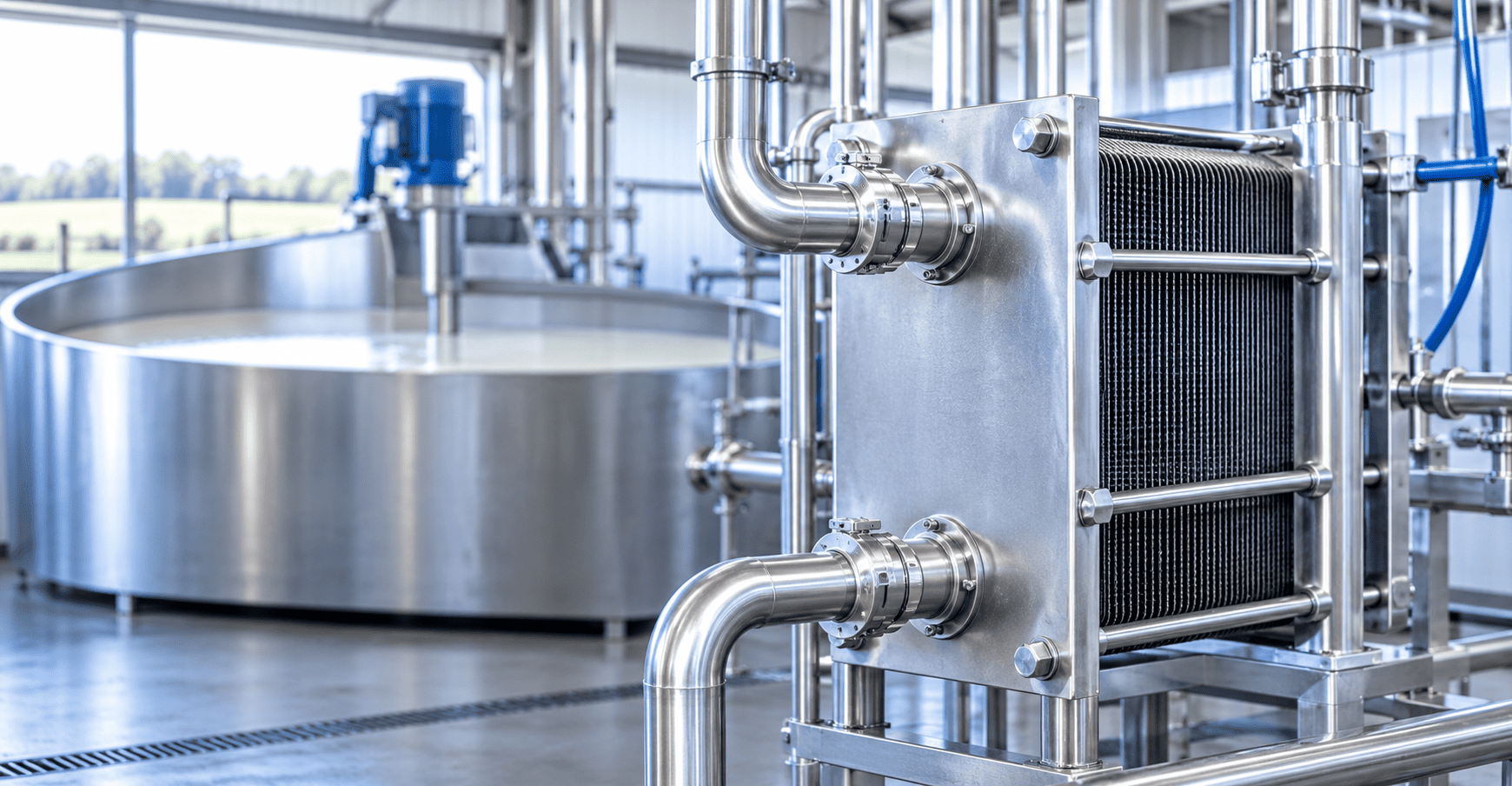
A plate heat exchanger (PHE) sits between your milking system and your bulk milk vat. Cold groundwater or chilled water flows in the opposite direction to warm milk, separated by stainless steel plates. Heat transfers rapidly from the milk to the water, without the two fluids ever mixing.
Here’s what that means in practice:
- Fresh milk leaves the cow at approximately 37–38°C
- Australian standards require milk to reach 5°C or below within two hours of milking
- A heat exchanger pre-cools milk to 12–18°C before it enters the vat, completing 50–70% of the cooling work your compressor would otherwise carry alone
- The result: faster cooling, less strain on your refrigeration system, and significantly lower energy bills
The Direct Link Between Rapid Cooling and Superior Milk Quality
Deterioration in milk quality is almost always due to temperature. Every minute warm milk sits above 7°C is an opportunity for bacteria to multiply. Bacterial counts, the core metric your processor measures, double roughly every 20 minutes in warm conditions. That’s not a small risk; it’s an exponential one.
What faster pre-cooling actively prevents:
- High Total Bacterial Counts (TBC) are the primary trigger for quality price deductions
- Elevated Somatic Cell Counts (SCC) linked to mastitis and increased udder stress
- Thermoduric bacteria that survive pasteurisation and affect downstream processing quality
- Flavour tainting caused by lipase activity, which accelerates with slow temperature drops
- Processor rejection during summer peaks or high-production periods
For farms already earning bonuses for quality milk, or those working to break into premium pricing tiers, faster cooling is one of the few quality levers entirely within your control.
The Hidden Cost of NOT Having a Heat Exchanger
Many farmers assume their bulk milk vat handles cooling adequately. It does, eventually. But without a heat exchanger, your compressor carries the entire thermal load every single milking. Over time, this creates real, measurable costs that most farms don’t account for:
| Without Heat Exchanger | With Heat Exchanger |
| Compressor runs at 100% thermal load | Compressor load reduced by 50–70% |
| Higher electricity consumption per milking | Measurable energy savings every milking |
| Faster compressor wear, shorter lifespan | Extended equipment life |
| Slower cooling = greater bacterial risk | Milk hits safe temp faster, lower TBC risk |
| More breakdowns in hot Victorian summers | Less strain, fewer emergency callouts |
The compressor is the most expensive component in your refrigeration system. Running it harder than necessary, twice a day, every day, accelerates wear, compounding quietly until you’re facing a major repair bill at the worst possible time.
5 Reasons Australian Dairy Farmers Are Installing Heat Exchangers
1. Energy Costs Are Rising. Pre-Cooling Is the Answer
With electricity prices across Victoria continuing to climb, cutting compressor run-time directly reduces your power bill. A properly sized heat exchanger doing 60% of the pre-cooling work translates to real dollar savings, twice a day, 365 days a year. For farms milking 200+ cows, annual savings can be substantial.
2. Australian Dairy Standards Are Tightening
Processors are increasingly scrutinising TBC and SCC results, and quality penalties are growing. A heat exchanger gives your milk an extra head start, hitting the right temperature faster and protecting your quality scores, even during the hot Victorian summers when ambient heat makes the compressor’s job harder.
3. It Protects Your Existing Refrigeration Investment
Your bulk milk vat and compressor are significant capital assets. Running them at full thermal capacity every milking ages them prematurely. A heat exchanger acts as a frontline workhorse, extending the operational life of your primary refrigeration equipment and reducing the frequency of costly repairs.
4. Groundwater Pre-Cooling Is Essentially Free Refrigeration
Many Victorian farms have access to groundwater at 14–18°C, cold enough to do significant pre-cooling work before the compressor even engages. Harnessing this free thermal resource through a heat exchanger is one of the most logical efficiency gains available to a modern dairy operation. You’re not paying to generate that cold; it’s already there.
5. Fast Payback, Long-Term Returns
Unlike many capital investments, heat exchangers have a well-documented payback period of 2 to 4 years, depending on herd size and electricity tariff. After that, the energy and maintenance savings are pure return. For farms expanding their herd, the case becomes even more compelling.
What to Look for When Sizing a Heat Exchanger for Your Farm
Not all heat exchangers are created equal. Here’s what our technicians at Kyabram Refrigeration assess before recommending a system:
- Herd size and milk volume per milking – determines required plate capacity and flow rate
- Water source temperature – groundwater vs. chilled water systems require different configurations
- Integration with your existing vat – compatibility with GEA/Westfalia or Packo milk vat systems
- CIP (Clean-in-Place) compatibility – essential for food safety compliance and ease of daily cleaning
- Future capacity planning – size for where your herd is heading, not just where it is today
Getting the sizing wrong is one of the most common mistakes – an undersized unit won’t achieve the pre-cooling targets, while an oversized one wastes capital. A site assessment makes all the difference.
Why Kyabram Refrigeration? Local Knowledge, Real Results
We’re not a national franchise. We’re a locally operated business that has been working alongside dairy farmers across the Goulburn Valley and central Victoria since 1998. Our licensed refrigeration mechanics understand the demands of Victorian dairy farming because we’re servicing these farms every day.
- Authorised dealers for GEA (Westfalia) and Packo Milk Vats
- All technicians are ARC-licensed refrigeration mechanics
- Extensive spare parts inventory for all major vat brands. No waiting weeks for parts
- 24/7 emergency breakdown support
- Over 40 years of combined experience in dairy farm refrigeration
We’ve seen what works and what doesn’t across hundreds of farms in this region. When we recommend a heat exchanger, it’s because we’ve watched them transform milk quality and reduce operating costs on farms just like yours.
Frequently Asked Questions
Q: How much does a heat exchanger cost to install in Australia?
Installation costs vary depending on farm size, water source, and system complexity, but most dairy farm heat exchangers range from $3,000 to $10,000 installed. Given the energy savings and quality benefits, payback is typically achieved within 2–4 years.
Q: Can a heat exchanger be retrofitted to my existing milk vat?
Yes, in most cases. Plate heat exchangers can be integrated into existing dairy infrastructure, including GEA, Westfalia, and Packo systems. Our technicians assess your setup and design a solution that works with your current equipment rather than replacing it.
Q: Do I need town water or groundwater to run a heat exchanger?
Either can work. Groundwater is ideal if your bore temperature is 18 °C below, making pre-cooling highly efficient and cost-effective. Town water or chilled water systems are also viable alternatives. We assess your water source during every consultation.
Q: How is a heat exchanger cleaned and maintained?
Most modern plate heat exchangers are CIP (Clean-in-Place) compatible and are cleaned as part of your regular dairy washdown routine. Annual inspections by a licensed refrigeration mechanic are recommended to check plate integrity and flow performance.
Q: Will a heat exchanger reduce my electricity bill?
Yes, measurably so. By handling 50–70% of the pre-cooling load, you significantly reduce compressor run time. The exact savings depend on your herd size, tariff, and milking frequency, but most farms report noticeable reductions in their electricity bills within the first billing cycle.
Q: Is a heat exchanger worth it for a smaller herd (under 150 cows)?
It depends on your electricity costs and water source. For farms with accessible cold groundwater, the economics often stack up even at smaller herd sizes. We’re happy to run through the numbers honestly with you; there’s no obligation.
Q: Does Kyabram Refrigeration service farms outside Kyabram?
Yes. We service dairy farms across the broader Goulburn Valley and central Victoria region, including surrounding towns and rural properties. Call us to confirm coverage for your area.
Ready to Cool Smarter? Talk to Kyabram Refrigeration
If you’re serious about protecting your milk quality, reducing your energy costs, and getting more life out of your refrigeration equipment, a heat exchanger is the place to start.
Kyabram Refrigeration has been installing, servicing, and optimising dairy farm refrigeration systems across central Victoria for over 40 years. We’re not here to sell you something you don’t need. We’re here to help you get the best results from your farm.
Call us: (03) 5852 1212, Email: info@kyabramrefrigeration.com.au, 267 John Allan Road, Kyabram, VIC
Book a no-obligation farm assessment today, and find out exactly what a heat exchanger could do for your operation.