
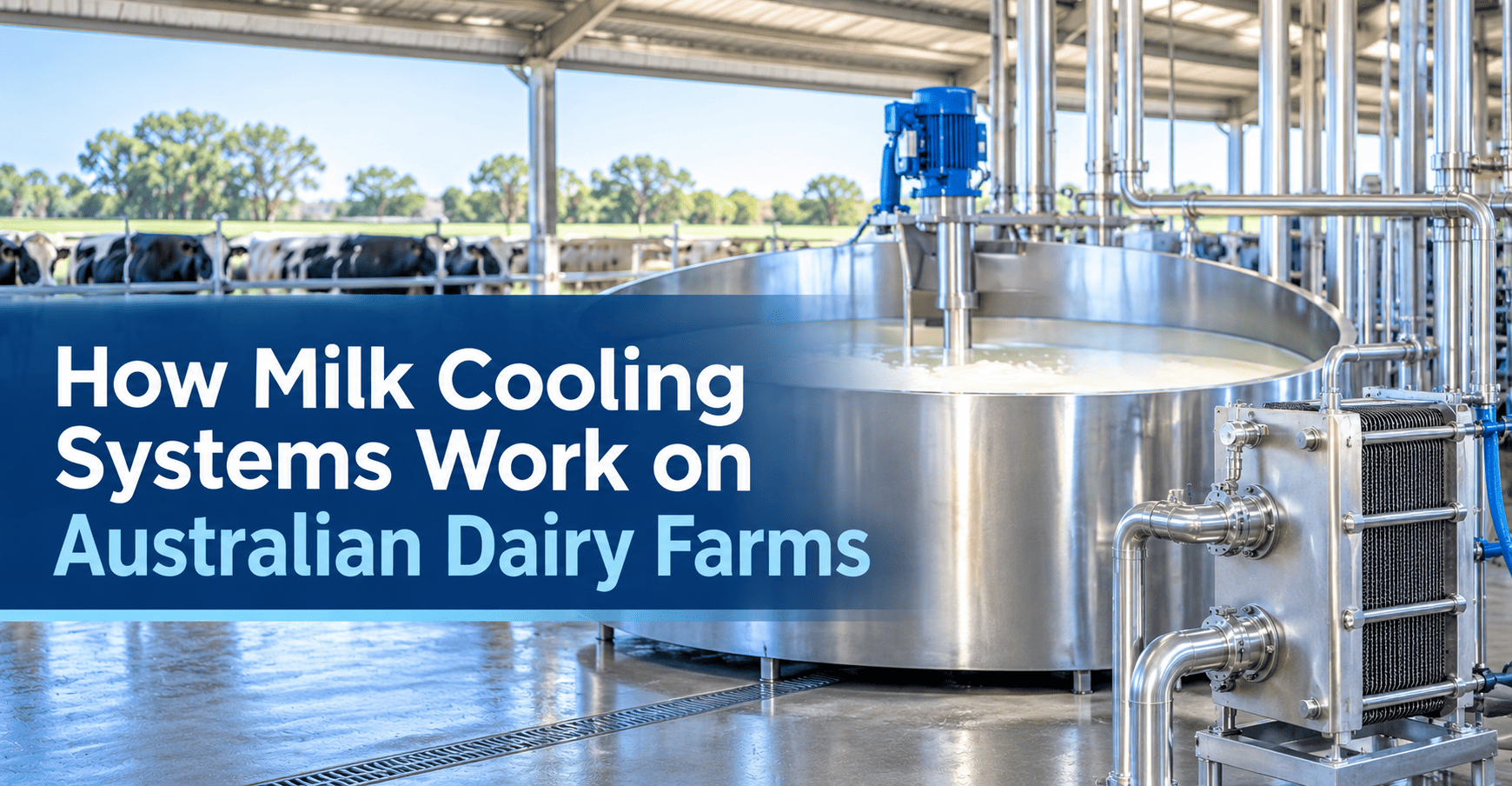
If you’re running a dairy farm in Australia, you already know that the first few hours after milking are just as important as the milking itself. Raw milk leaves the cow at around 35°C to 38°C, and from that moment, every minute counts. Getting that milk cooled down quickly and correctly is the difference between a premium quality result and a rejected load.
This guide breaks down exactly how milk cooling systems work, the main types of systems, and what every Australian dairy farmer should understand about their setup.
Why Rapid Milk Cooling Is Non-Negotiable
Raw milk is a living product. As soon as it leaves the cow, bacteria start to multiply. At body temperature, bacteria can double every 20 minutes. If milk is not cooled properly, it could have high bacterial levels by the time the tanker arrives, which may cause it to fail processor tests.
Rapid cooling slows down bacterial growth. It also protects fat, maintains high protein quality, and preserves the flavour both processors and consumers want.
In Australia, dairy farms must follow the national Food Standards Code, which sets strict rules on how quickly and how much raw milk must be cooled. These are not just best practices; they are legal requirements, and groups like Dairy Food Safety Victoria (DFSV) and other state bodies check that farms follow them.
Besides meeting the rules, there is also a clear financial benefit. Australian processors pay bonuses for milk with low bacteria and somatic cell counts. A good cooling system helps you earn those bonuses.
The Two Main Milk Cooling Systems Used on Australian Dairy Farms
-
Direct Expansion Vats
The direct expansion (DX) vat is the most widely used milk cooling system across Australian dairy farms, particularly on small to mid-sized operations. It’s an all-in-one solution in which the refrigeration system is built directly into the vat.
Here’s how it works step by step:
Warm milk moves from the milking shed into the vat. Refrigerant runs through coils in the vat’s walls or base. When the milk touches these cold surfaces, the refrigerant absorbs heat and carries it away. The compressor then sends the heated refrigerant to the condenser, usually outside the shed, where the heat is released into the air. The refrigerant then returns to the system to repeat the process.
An agitator keeps the milk constantly moving inside the vat. This matters because if milk sits still, the top stays warmer while the bottom cools faster. The agitator ensures the entire batch cools evenly.
DX vats are simple, reliable, and widely used. Their main drawback is that the vat’s refrigeration system does all the cooling. In hot weather or when a lot of warm milk is added at once, the system has to work extra hard to keep up.
-
Glycol Pre-Cooling Systems
Glycol pre-cooling is an increasingly popular solution on larger Australian dairy farms and those looking to reduce energy costs and system strain. Rather than relying entirely on the vat to cool the milk, a glycol system does most of the cooling work before the milk even reaches the vat.
A glycol chiller cools a water-glycol mixture, typically overnight when off-peak electricity tariffs apply. That chilled glycol solution is then pumped through a plate cooler or an inline heat exchanger mounted between the milk pump and the vat. As warm milk flows through the heat exchanger, it transfers heat directly to the cold glycol, lowering the milk temperature from around 37°C to between 4°C and 10°C before it ever touches the vat.
The vat then only needs to do the final cooling to storage temperature. This dramatically reduces compressor run time, lowers electricity costs, and extends the working life of the vat refrigeration unit by reducing total operating hours.
Glycol systems are particularly well-suited to farms milking larger herds or running twice-daily milking with high volumes. The upfront investment is offset by long-term energy savings and reduced wear on the primary vat system.
Key Components Every Dairy Farmer Should Understand
Regardless of which system you’re running, these components are at the heart of your milk cooling setup:
-
Compressor
The compressor is the engine of the refrigeration system. It compresses refrigerant gas and drives the entire cooling cycle. It’s also the most expensive component to replace, which is why protecting it through regular maintenance matters.
-
Condenser
The condenser expels heat collected from the milk to the outside air. In hot Australian summers, a dirty or blocked condenser has to work much harder, reducing system efficiency and potentially causing the compressor to overheat. Keeping condenser coils clean is one of the most straightforward and impactful maintenance tasks on any dairy farm.
-
Expansion Valve
The expansion valve controls refrigerant flow into the evaporator coils. A faulty expansion valve affects the system’s ability to absorb heat, leading to uneven cooling or extended pull-down times.
-
Temperature Probe and Controller
The temperature probe and controller are your window into what the system is actually doing. Modern vat controllers log milk temperature throughout the storage cycle, giving you and your processor a verifiable record. An uncalibrated probe or a faulty controller can give false readings that mask real temperature compliance issues.
-
Agitator
The agitator keeps milk moving. Without proper agitation, milk near the cooling surfaces chills quickly while milk in the centre of the vat stays warm, creating uneven bacterial conditions and inconsistent temperature readings.
Heat Recovery: Making Your Cooling System Work Harder for You
One feature that’s worth mentioning is the heat recovery unit. Every refrigeration system expels heat through its condenser; that’s just how the refrigeration cycle works. A heat recovery unit captures that expelled heat and redirects it to your hot water system.
On a working dairy farm, hot water demand is significant. Shed wash-down, plant cleaning, vat washing, and cup washing all require hot water. Running a heat recovery unit means you’re generating a large portion of that hot water essentially for free, as a by-product of your existing cooling system.
Many Victorian dairy farmers who install heat recovery units report saving thousands of dollars per year in gas or electric hot water costs. It’s one of the smartest efficiency upgrades available.
Common Milk Cooling Problems on Australian Dairy Farms
Even well-maintained systems run into issues. These are the signs that something isn’t right:
-
Slow Cooling Times
Milk is taking longer than usual to reach the required storage temperature. This can indicate a low refrigerant charge, dirty condenser coils, or an undersized system for the current herd volume.
-
Compressor Running Constantly
The compressor is running almost continuously. Occasional extended run times during extreme heat are normal, but constant operation often points to a refrigerant issue, blocked airflow around the condenser, or a failing component.
-
Inconsistent Temperature Readings
Temperature logs show inconsistent readings. Uneven cooling across the vat can indicate agitator problems, a failing temperature probe, or improper milk flow into the vat.
-
Unusual Compressor or Agitator Noises
Unusual noises from the compressor or agitator motor. Grinding, rattling, or squealing are early warning signs that shouldn’t be ignored.
Catching these issues early with routine servicing is far cheaper than an emergency callout during a summer heatwave or a failed load at the processor.
Keep Your Milk Cooling System Running at Its Best
Kyabram Refrigeration has been servicing dairy farms across Victoria since 1998. Based in Kyabram and serving the Goulburn Valley and surrounding regions, we supply and service all major milk vat brands, including GEA, Packo, Mueller, Boumatic, Zero, and Ro-Ka Viking.
Whether you need a routine service, a glycol system installation, spare parts, or emergency support, our team at Kyabram Refrigeration is ready to help. We’re fully authorised by the Australian Refrigeration Council (ARC) and run a dedicated dairy emergency line for urgent callouts.
Call (03) 5852 1212, reach the dairy emergency line on 0417 010 664, or visit kyabramrefrigeration.com.au to get in touch with us today.
Frequently Asked Questions
How does a milk vat cool milk so quickly?
A milk vat uses a refrigeration system built into its walls or base. Refrigerant circulating through the vat coils absorbs heat from the warm milk. An agitator keeps milk constantly moving to ensure even, consistent cooling throughout the entire volume of milk in the vat.
What is a glycol pre-cooler and do I need one?
A glycol pre-cooler chills milk before it reaches the vat by circulating a refrigerated glycol solution through a heat exchanger. It reduces the cooling load on your vat, lowers energy costs, and extends equipment life. It’s most beneficial on larger farms or those looking to reduce peak energy consumption.
What are the main components of a dairy farm milk cooling system?
The key components are the compressor, condenser, expansion valve, evaporator coils (built into the vat), agitator, temperature probe, and vat controller. Each plays a specific role in the cooling cycle, and a fault in any one of them can affect overall cooling performance.
How often should dairy farm refrigeration equipment be serviced?
At a minimum, once a year before the summer season. Many experienced dairy farmers in Victoria schedule a pre-summer service in spring and a mid-year inspection. Condenser coils should be cleaned more frequently on farms near dusty paddocks or during harvest.
What is a heat recovery unit and is it worth installing?
A heat recovery unit captures the waste heat expelled by your refrigeration compressor and redirects it to heat water for your dairy shed. Given the high hot-water demands of a working dairy operation, most farms find that the installation pays for itself relatively quickly through reduced gas or electricity bills.