
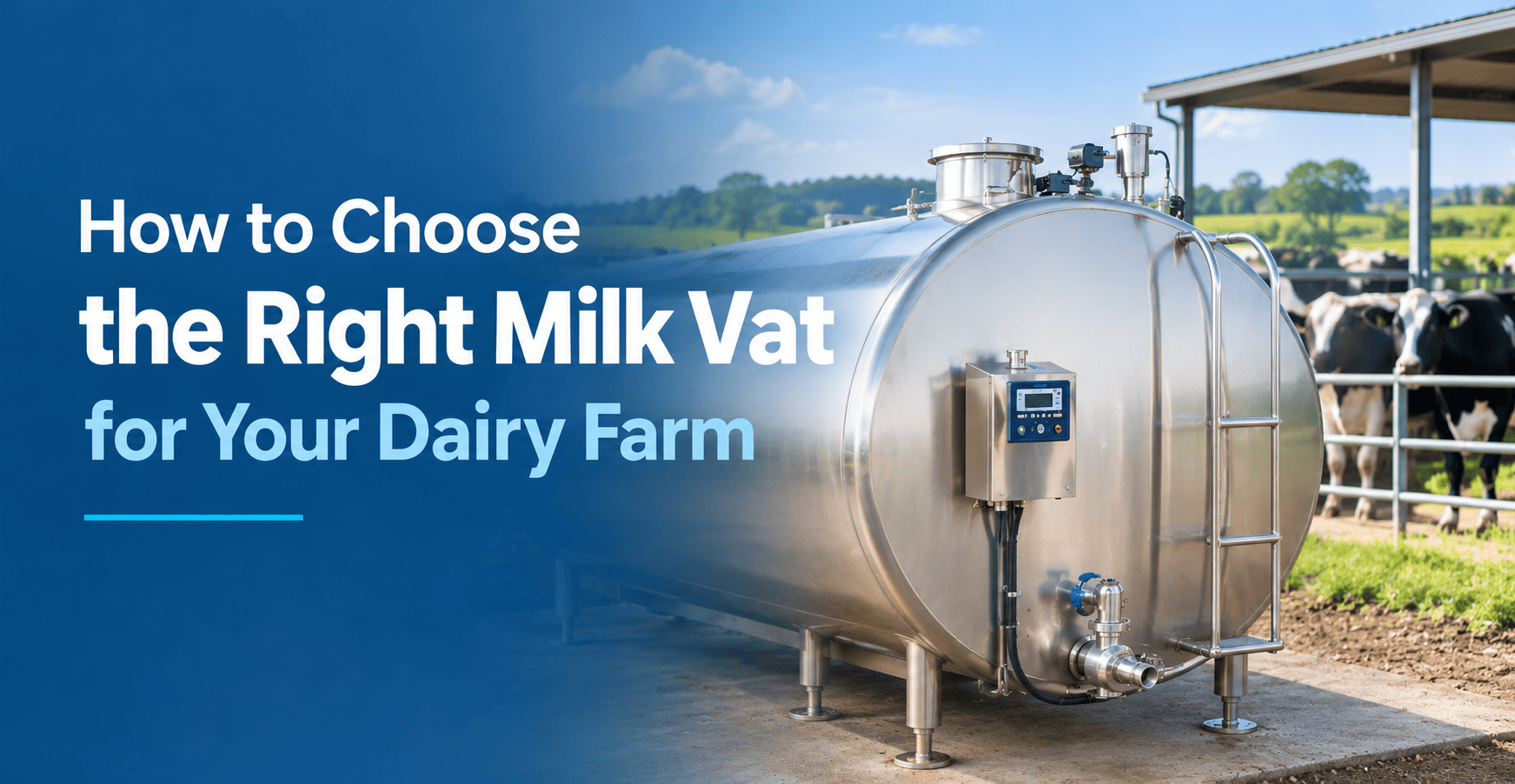
The right milk vat to select must take into account four factors: capacity suitable for your herd size and pickup schedule, cooling performance that meets food safety requirements, build quality from a reputable brand, and after-sales support you can count on. If you ensure that these points are addressed, your vat will serve your farm reliably for many decades.
Anyone who is a dairy farmer in Victoria and is currently considering buying a new milk vat will already be aware that it is not something you should decide on quickly. A milk vat represents one of the largest investments you will ever make on a farm, and making the wrong choice can lead to wasted milk, trouble with compliance, and costly repairs in the future.
In this blog, we talk about how to choose the right milk vat for your dairy farm, covering capacity, cooling performance, construction, refrigeration systems, servicing, energy efficiency, and long-term support.
Start With Your Herd Size and Growth Plans
The vat should be able to cope with your current production rate while also providing some room for future growth.
Think about:
- Current daily milk output across your milking herd
- Your milk pickup frequency (daily, every second day, or longer in some regions)
- Any planned herd expansion over the next five to ten years
- Seasonal calving patterns that might spike production
If the vat is too small, you will constantly operate at capacity limits and risk overflow or inadequate cooling. If it is too large, you will pay more initially and run an inefficient refrigeration system when the capacity is only partially used.
Cooling Speed and Compliance
The regulations set out by the Australian dairy authorities require that milk be cooled to 5°C within a specified time after milking; this is not open to negotiation, as it is a food safety requirement and is monitored by the processor.
Look for a vat with:
- A cooling rate proven to hit compliance targets even on hot days
- Efficient agitation to prevent hot spots and cream separation
- A reliable refrigeration unit sized correctly for the vat volume
One of the most frequent problems we come across during visits to farms is undersized refrigeration: although the vat itself may be all right, cooling times are much longer because the compressor and condenser are not matched to the vat’s volume.
Vat Construction and Brand Reputation
Vats are not all constructed in the same way; the grade of the stainless steel, the quality of the insulation, and the welding standards all affect how long the vat will last and how well it can retain temperature.
Brands that have for a long time been used on dairy farms in Australia, such as GEA (Westfalia), Packo, have designs which have been proven to be suitable for our climate and milking systems; moreover, these brands generally enjoy better availability of spare parts in later years, a factor that is important when a component needs to be replaced.
Direct Expansion vs Ice Bank Systems
The majority of modern milk storage tanks employ direct-expansion refrigeration because it cools milk rapidly and is suitable for most herd sizes. Ice bank systems, on the other hand, involve accumulating ice during the night to meet sudden cooling demands, and they are appropriate for farms with very high peak cooling demands or an unreliable power supply. A refrigeration technician can tell you which system is best suited to your farm’s specific circumstances.
Consider New vs Used
New vats come with complete warranties, are fitted with the most recent energy-efficient compressors, and have no unknown past history; used vats, provided they are properly inspected and serviced, can be a wise approach for obtaining good equipment at a reduced initial cost, especially for farms that are only just starting out or those who wish to keep their capital.
No matter which way you decide to go, you should purchase from a supplier who actually knows about dairy refrigeration, not just from a general equipment dealer.
Don’t Overlook Servicing and Parts Access
The value of a vat depends entirely on the support that underlies it. Before making a purchase, ask yourself:
- Will a technician need to wait for days, or will local service be available?
- Are the spare parts readily available, or are they custom-ordered from overseas?
- Is there an emergency callout service if the vat fails during a heatwave?
A breakdown during summer isn’t just inconvenient; it can mean a full vat of milk lost within hours. Local support and parts availability should weigh heavily in your decision.
Energy Efficiency Matters Long Term
Refrigeration is one of the biggest power costs on a dairy farm. Vats with variable speed drives (VSDs) on compressors and efficient heat recovery systems can significantly cut running costs over the vat’s lifespan, sometimes paying back the extra upfront cost within a few years through lower power bills.
Choose the Right Milk Vat for Your Farm
Choosing the right milk vat is a long-term investment, and getting the capacity, cooling system and servicing support right matters. If you’re unsure which vat suits your herd and farm, Kyabram Refrigeration can help you compare your options. Discuss your herd size, pickup schedule, budget and future plans with a dairy refrigeration specialist before making your decision. Go to Kyabram Refrigeration to know more.
Frequently Asked Questions
What size milk vat do I need for my herd?
As a general guide, vat capacity should cover at least one to two days of milk production based on your pickup schedule, with some spare capacity for growth and seasonal peaks.
How long does a milk vat last?
A well-maintained stainless steel milk vat from a reputable brand can last 20 to 30 years or more, while the refrigeration components typically need servicing or replacement sooner.
Would a used milk tank be a good choice?
Yes, but only if it is properly inspected, has a solid service record, and the refrigeration system is tested before purchase; the risk can be greatly reduced by purchasing through a specialist supplier.
What is the difference between direct expansion and ice bank vats?
With direct expansion vats, milk is cooled directly via refrigerant coils and is therefore suitable for most standard herd sizes. Ice bank systems store cooling capacity as ice, which helps manage very high or irregular peak loads.
How frequently should a milk vat be serviced?
It is advisable to have most dairy vats given a full service at least once every year, preferably before the hotter months when the need for cooling is greatest.