
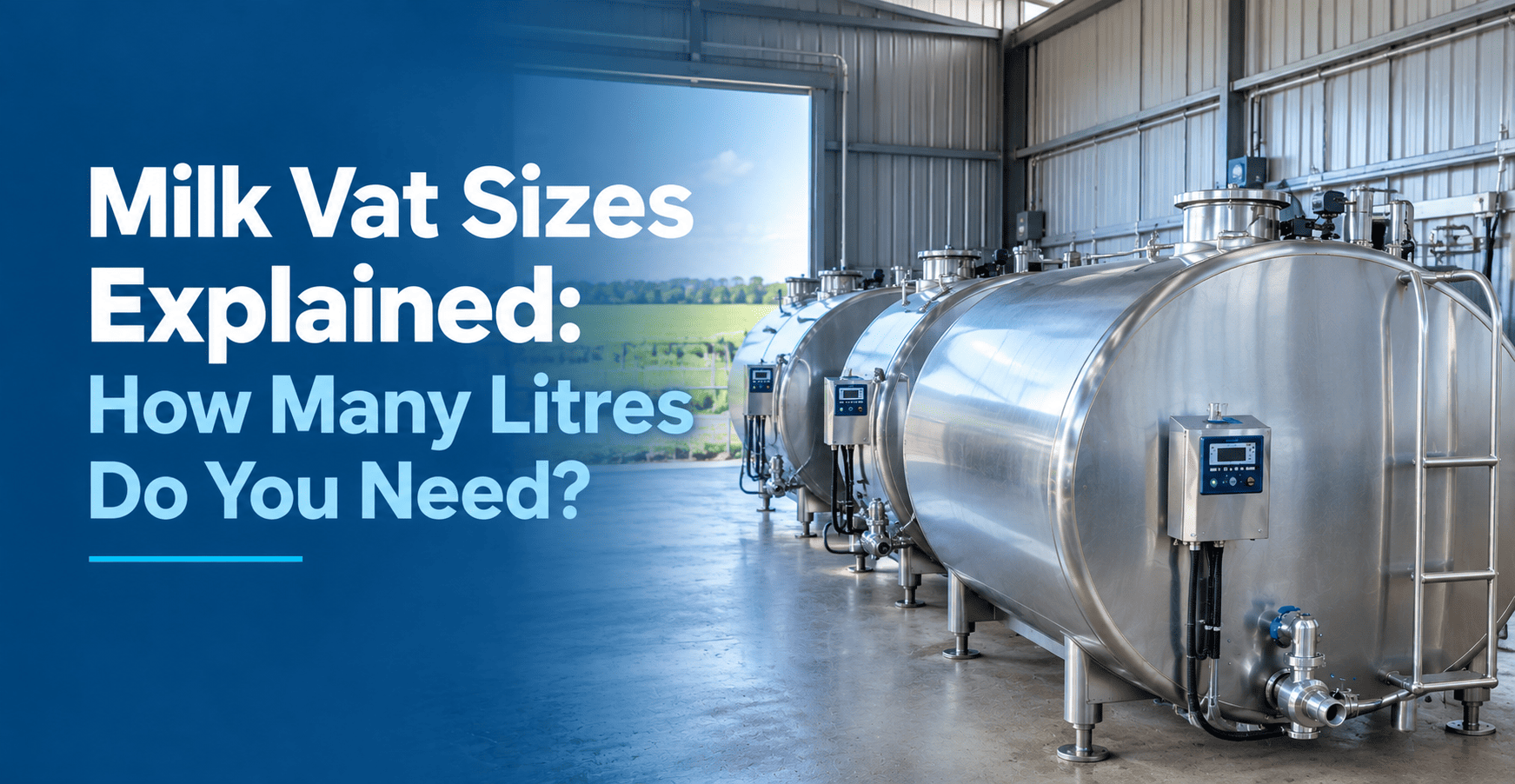
The milk vat should usually have a capacity equal to one or two days’ worth of production according to your milk pickup schedule, taking into account expected growth and seasonal peaks. Typical capacities vary from about 2,000 litres for smaller operations to 30,000 litres or even more for large commercial dairies, the suitable size being determined by the number of cows, the yield per cow, and how frequently the milk is collected.
It is more important than many farmers realise when setting the size of the vat. If it is too small you could have overflow or fail to meet the cooling requirements on high-production days, and if it is too large you will be paying for capacity and running costs that you don’t need.
The article deals with the method of working out the appropriate size for a milk vat on your dairy farm, taking into account the number of cows in the herd, the daily production, how often the milk is collected, seasonal variations, future expansion, and the practical problems that arise when selecting a vat that is too big or one that is too small.
The Basic Formula
Start with three numbers:
- Number of milking cows
- Average daily milk yield per cow (litres)
- Days between milk pickups
To calculate the daily production, multiply the number of cows by the average yield and then multiply that figure by the frequency of pickups to obtain the minimum capacity needed. Most farmers then include a buffer of 15 to 20 per cent to cover seasonal peaks, calving spikes, and future growth.
Example Calculation
A herd of 200 cows, each averaging 25 litres per day, produces a total of 5,000 litres per day. Since the milk is collected every two days, the minimum amount required is 10,000 litres. When a 20 per cent buffer is included to cover peak periods, the practical target becomes about 12,000 litres.
This is only a general guide, and the figures you use must be based on data from your particular herd and on how you arrange your livestock collection with your processor.
Common Milk Vat Sizes in Australia
While exact ranges vary by manufacturer, typical vat capacities on Australian dairy farms include:
- 2,000 to 5,000 litres — smaller operations or farms with frequent pickups
- 5,000 to 10,000 litres — small to mid-sized herds
- 10,000 to 20,000 litres — mid-sized to larger operations
- 20,000 to 30,000+ litres — large commercial dairies with high production volumes
Factors That Affect the Right Size for You
Pickup Frequency
Farms that have their waste collected on a daily basis are usually able to use smaller vats than those whose waste is collected every other day or every third day. It is important to check your processor’s collection schedule before deciding on the size of the vat.
Seasonal Variation
The pattern of calving leads to natural fluctuations in daily production. Since a vat that is only the size of the average output would have difficulty during the weeks when calving is at its peak, you should plan for your highest production weeks and not merely for the annual average.
Herd Growth Plans
It usually pays to plan the size of the vat in line with your future herd expansion plans now, rather than carrying out an upgrade shortly after the vat is installed.
Milking System and Farm Layout
The layout of your dairy shed and the capacity of your milking system can also affect the actual size of the vats, especially on farms with space limitations or specific plumbing arrangements.
Why Oversizing Isn’t Always Better
It might seem safer to buy the biggest vat you can afford, but oversizing has real downsides:
- Higher upfront purchase cost
- Increased power consumption running a partially filled vat
- Less efficient cooling performance on smaller milk volumes
- Larger footprint required in your dairy shed
The aim should be to choose a vat that is the right size for your current and future needs, not merely to go for the largest one available.
Getting the Sizing Advice Right
Since vat sizing involves a number of factors specific to individual farms, it’s a good idea to go through the calculations with someone experienced in dairy cooling systems. A brief discussion about the size of your herd, trends in your milk yield, and your pickup schedule generally makes the appropriate capacity obvious.
Find the Right Milk Vat Size
Choosing the right vat capacity will help you avoid extra expenses, cooling issues, and the need for an early upgrade. It is far easier to work out the correct vat size if you have accurate readings of your herd’s real production figures and know your processor’s pickup schedule. Since 1998, Kyabram Refrigeration has been advising Victorian farmers on the sizing of their dairy cooling systems and is willing to go over the figures with you.
It’s a good idea to consult a dairy refrigeration specialist before finalising a vat size and to ensure that your investment meets both your current farm requirements and your future plans. For further information, visit Kyabram Refrigeration.
Frequently Asked Questions
How big a milk vat do I need for 100 cows?
As a very rough estimate, 100 cows which each produce an average of 25 litres per day will yield about 2,500 litres each day. Given that the collection is carried out every two days and allowing for periods of peak production, a vat sized between 5,000 and 6,000 litres would generally be appropriate, although your own figures should verify this.
What amount of buffer capacity should I include in my calculation of the size of my milk vat?
Most farmers set their amount at 15 to 20 per cent above the figure they have calculated to allow for seasonal peaks, calving spikes, and short-term increases in production.
May a milk vat be larger than my herd?
Yes, although an oversized vat has a higher initial cost, requires more power in order to cool partial loads efficiently, and occupies unnecessary space, it is important to match the size to actual requirements.
Does the frequency with which you pick up the material actually affect the size of the vat that you need?
Certainly. A farm that collects its produce daily can often operate with a vat about half the size of one used for a two-day collection cycle, provided production is the same.
Should I base the size of my milk vat on the current number of cows in the herd or on future growth?
If herd expansion is planned within the next few years, sizing slightly above current needs can save the cost and disruption of an early vat upgrade.